Quoted by The Hindu
October 18, 2026
illuminem
Oct 18, 2026

Interview link: https://illuminem.com/illuminemvoices/given-the-severe-consequences-this-risk-should-be-taken-very-seriously-dr-susanne-ditlevsen-on-amoc
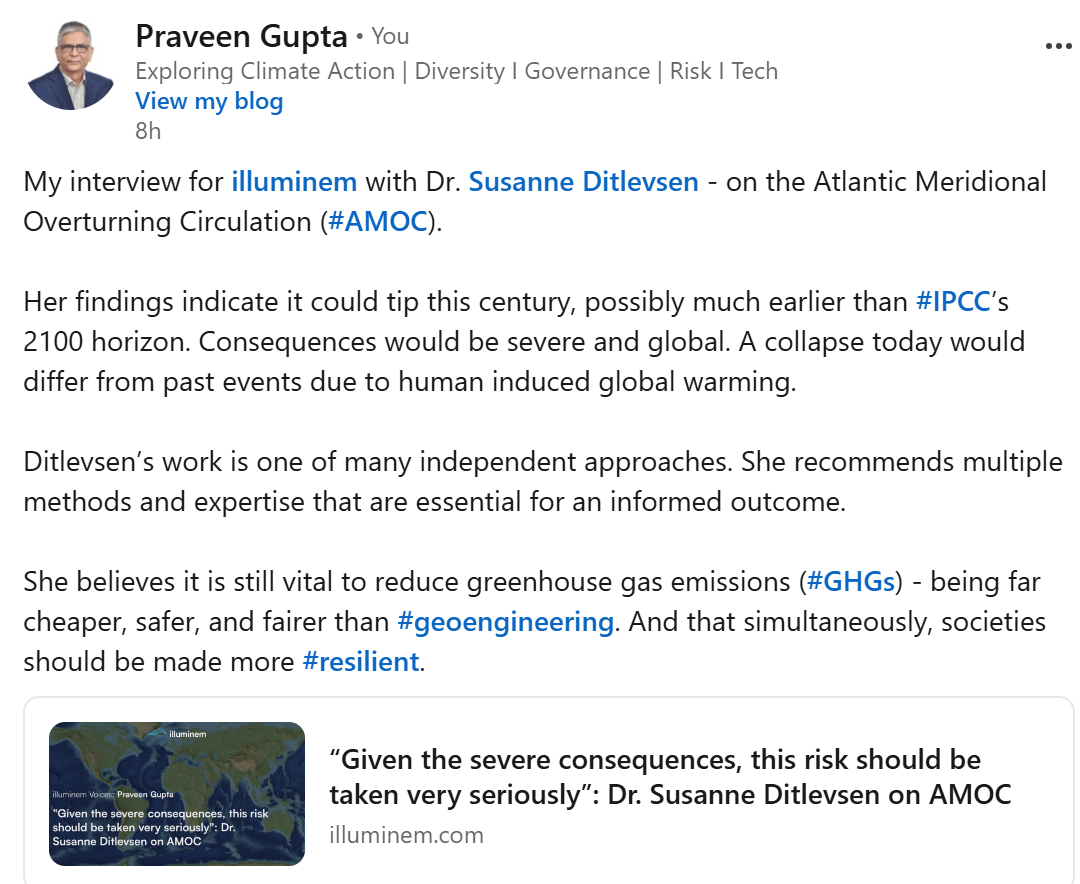

Susanne Ditlevsen is President of the Royal Danish Academy of Science and Letters. She is Professor of statistics and stochastic models in biology at University of Copenhagen. Together with her brother Peter Ditlevsen this team of two have done some remarkable work on the Atlantic Meridional Overturning Circulation (AMOC) – a critical Earth system that could tip if we do not urgently bring human induced emissions under check.
The tipping could have far reaching consequences across the planet. We do not have the luxury of the timeline IPCC suggests – which goes into 2100. The Ditlevsen work indicates it could happen as early as 2037. Iceland is the only country that has accepted this probability and declared a national security threat.
“I think we should still work hard for reducing greenhouse gas emissions”, believes Susanne. She appeals for designing a resilient society. “This problem is so complex that we need to attack it from many different angles”. Global cooperation is her mantra.
Praveen Gupta (PG): Your insights into how soon might the AMOC tip?
Susanne Ditlevsen (SD): I believe there is a non-negligible risk that it might happen/start in this century – given the severe consequences, this risk should be taken very seriously.
PG: AMOC has had a history of tipping. Does a predominant anthropocentric trigger make the manifestation any different?
SD: A possible collapse today will most likely be different from previous tipping because of global warming. We know little about how global warming will interact with a collapse, for that we rely on large climate models.
“Research groups have different expertise, and we should all contribute with what we can”
PG: Fundamental difference between your and IPCC’s methodologies?
SD: IPCC summarizes the existing knowledge in the scientific literature, in that sense one cannot compare methodologies as such. The current research on the AMOC is conducted by many independent groups and uses many different methodologies and data sets – as it should be.
This problem is so complex that we need to attack it from many different angles. Each method will have its pros and cons, and uncertainties will be different. We need to conclude on the basis of all the evidence we have. Research groups have different expertise, and we should all contribute with what we can.
PG: Does CO2 emission tend to get higher attribution vis-à-vis biodiversity loss and pollution?
SD: CO2 emissions is pollution of the atmosphere and leads to global warming. Biodiversity loss will happen in certain places due to global warming and changes habitat conditions, in other places it will not necessarily decrease biodiversity, but change the ecosystems (for example are many new whale species spending time in East Greenland, while endemic species are under pressure).
“I believe it is more straightforward, cheaper and safer to reduce emissions”
PG: Do you see any scope for mitigation, or have we run out of time for that?
SD: I think we should still work hard for reducing greenhouse gas emissions.
PG: Likewise, could adaptation do any good?
SD: One good thing would be to design our societies more resilient, for example, stop constructions of new building in areas that are exposed to flooding.
PG: Would we require some stop gap relief to pre-empt AMOC from tipping? Could that come from geo-engineering (SRM)? Damming of Bering Strait?
SD: I would not rely on geoengineering. First, we might not know exactly how to do it, nor understand completely about side effects. Second, we bind ourselves to continue for many generations to come. What if such geoengineering suddenly breaks down, say, 100 years from now? Then there might be a much quicker and more severe change.
I believe it is more straightforward, cheaper and safer to reduce emissions, and this is much more fair to the common generations that will not be forced to continue some geoengineering they did not choose.
PG: Many thanks, Dr. Ditlevsen. Look forward to following your pathbreaking work in this space. We have reached a point where BAU is just not sustainable.
illuminem
September 28, 2026

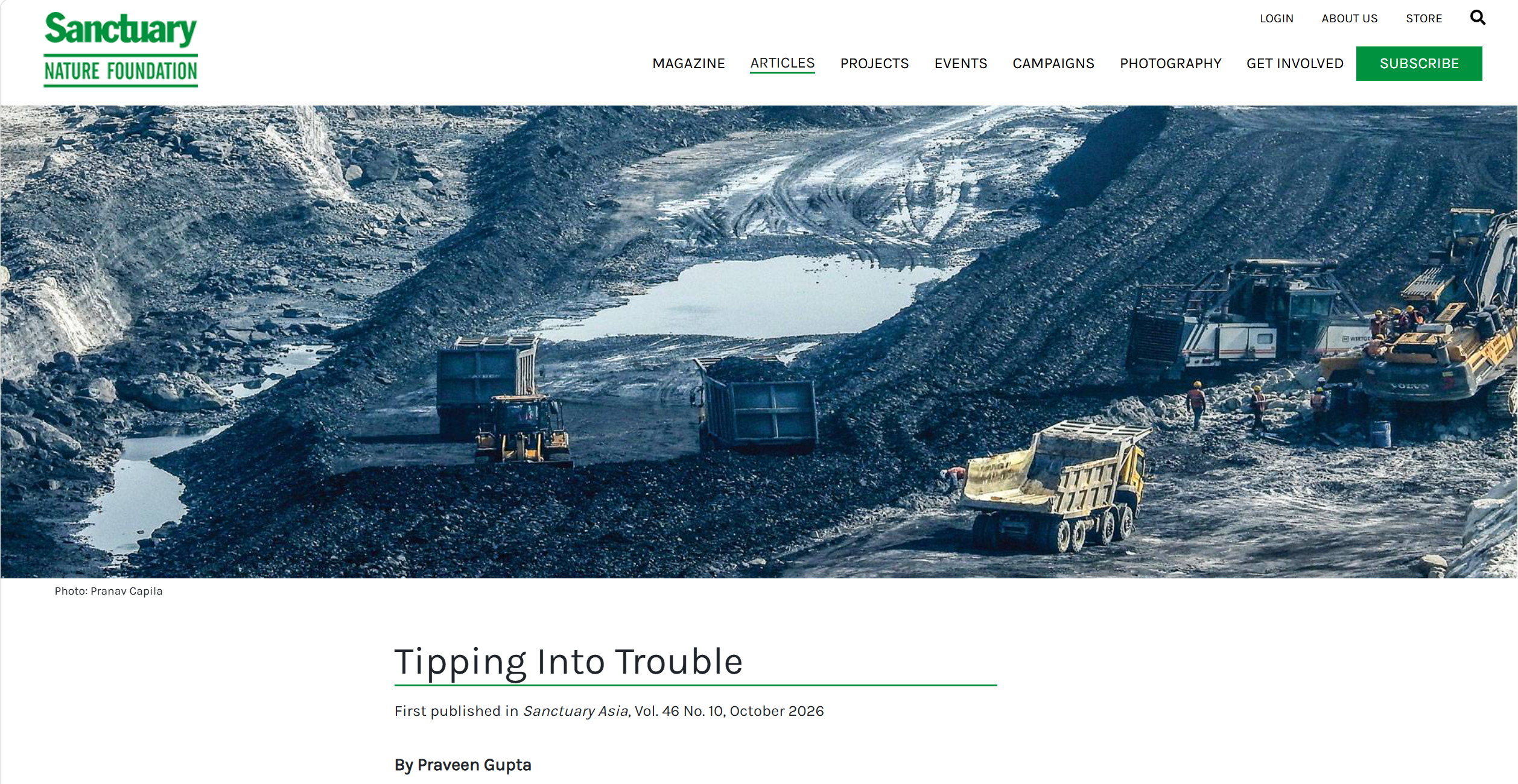
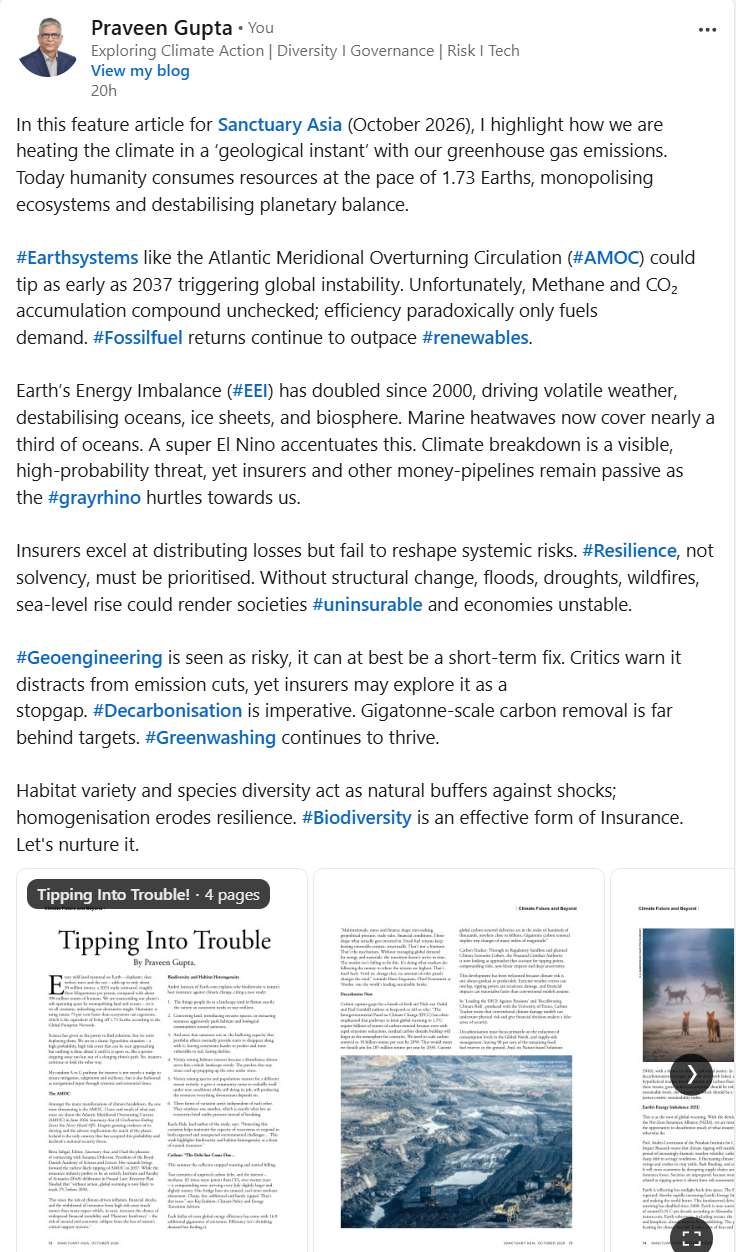
We are at the apex of a cliff | illuminem: This piece was originally published by Sanctuary Asia.
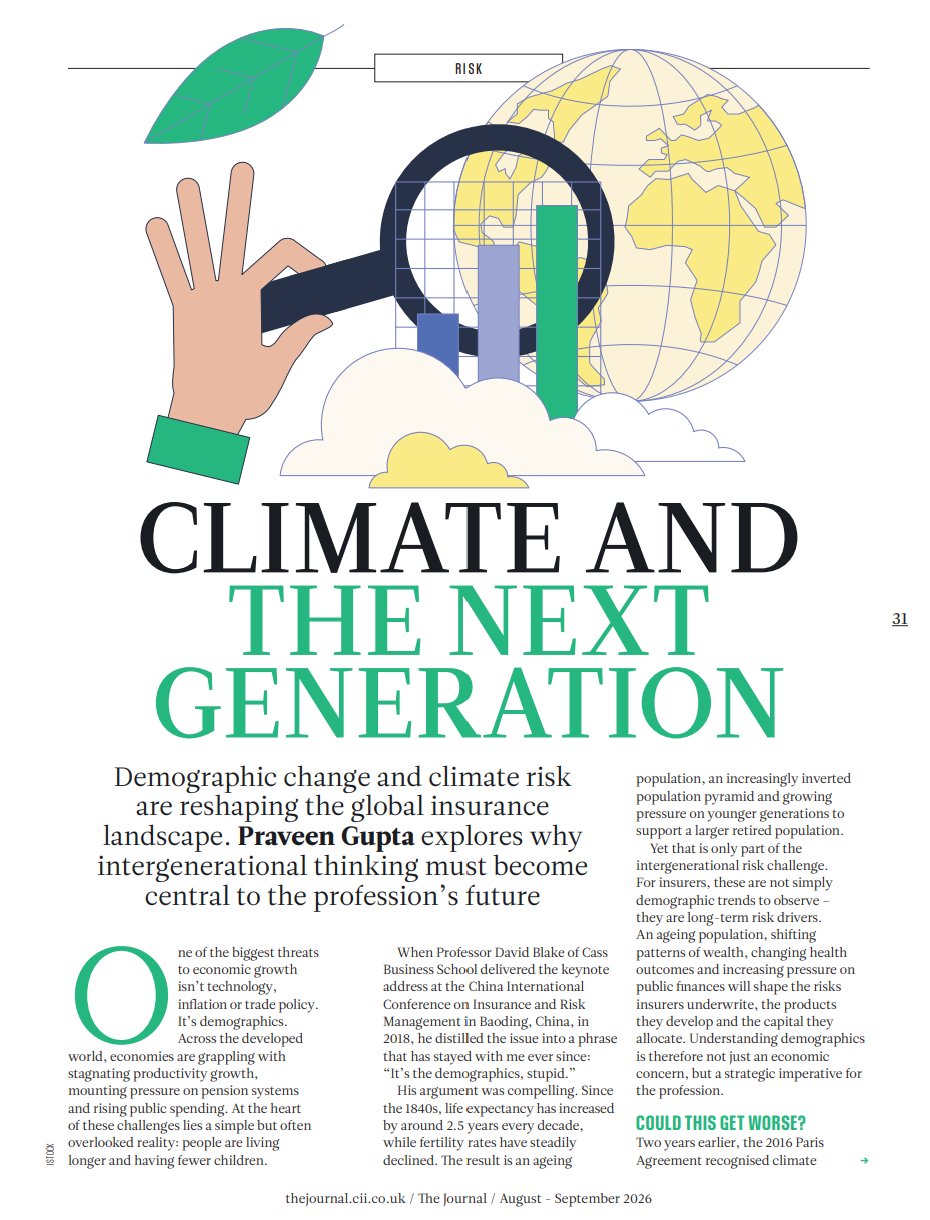
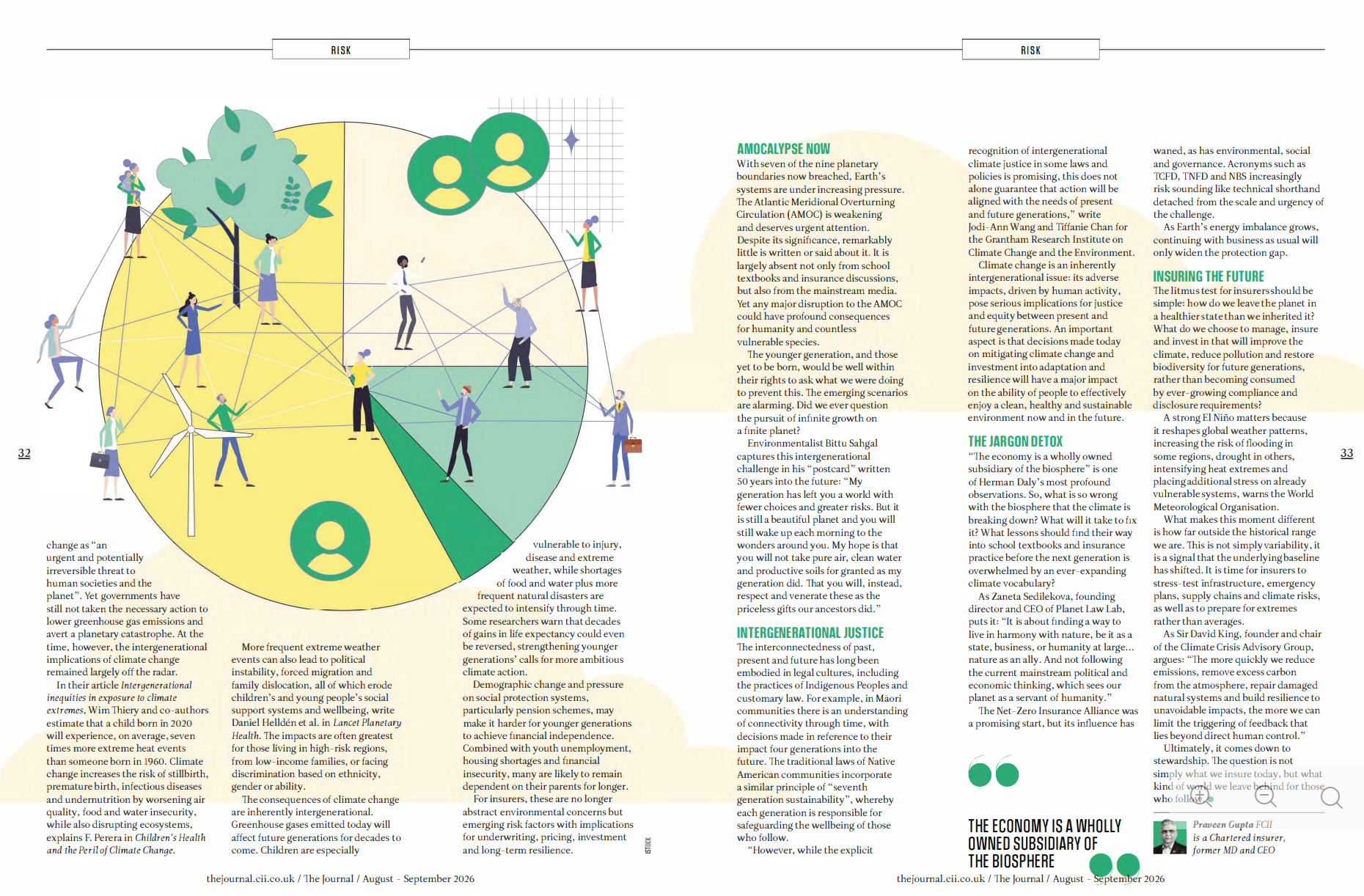
The Journal, Chartered Insurance Institute
August – September, 2026
illuminem
September 6, 2006
illuminem link: The atmosphere cares little for human concerns | illuminem
LinkedIn post: Post | Feed | LinkedIn
TOI Blogs
September 4, 2026
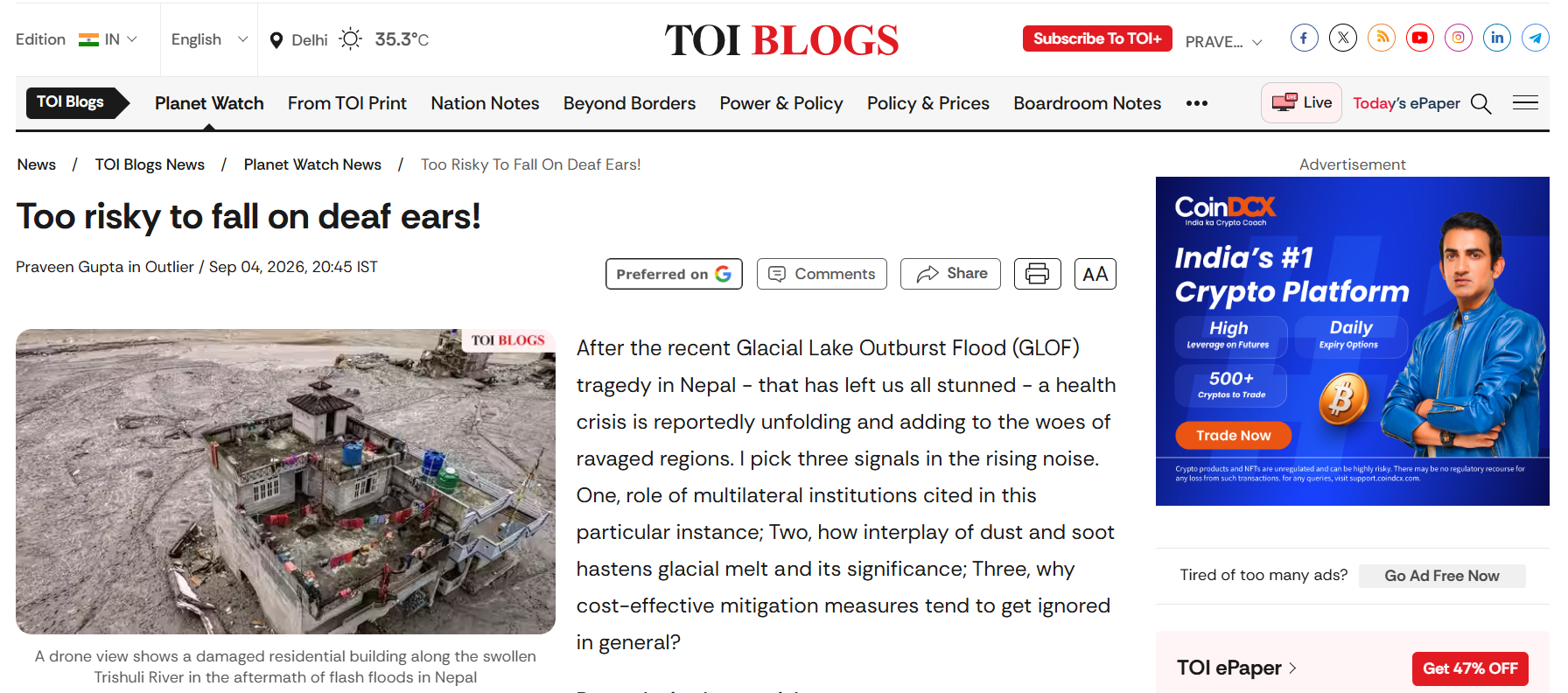
TOI Blog Link: Glacial Lake Outburst Flood (Glof): Too risky to fall on deaf ears! – The Times of India
LinkedIn post: https://www.linkedin.com/feed/update/urn:li:activity:7501673989791055873/

Dr. Chirag Dhara is a physicist and climatologist. His research interests involve climate science and impacts, and larger questions about the roots of the climate and ecological crises. Chirag’s parallel concerns are equity and social justice, human and natural rights, non-anthropocentric “valuation” of nature, and environmental conservation.
He holds a PhD in Earth Science from the Max Planck Institute for Biogeochemistry and the University of Hamburg in Germany. And a PhD in Physics, having earlier worked in theoretical quantum mechanics and quantum communication.
Chirag co-authored India’s first official climate assessment report in 2020 and was a contributing author to the IPCC AR6’s Atlas (2021). He has also written on climate and sustainability in Scientific American, Nature India, 360 Info, The India Forum, Mongabay India, The Hindu, among others.
Praveen Gupta (PG): Can climate rankings really reveal which country is a good performer?
Chirag Dhara (CD): Yes, but with critical caveats, and no single climate index can provide a definitive answer. For instance, the ‘Environmental Performance Index’ (EPI) by Yale/Columbia universities has a climate module that rates India among the bottom third of countries it assesses. On the other hand, the ‘Climate Change Performance Index’ (CCPI) developed by German Watch rates India among the top third of the countries it assesses.
The reason indices can differ widely is because they are designed to answer a specific question. For instance, the EPI is effectively asking “is this country’s marginal contribution to global warming rising or falling?” Whereas, the CCPI is asking “is this country appropriating more than its fair share of the atmospheric commons?”
Both are legitimate questions to ask and answer. Both are legitimate questions and both have defensible answers, which is why the same country can sit near the top of one table and the bottom of another.
“The key issue at hand is that ‘climate performance’ is a complex socio-economic and political question that defies a singular answer”
Yet, most often, the underlying question that an index is designed to answer is not made evident. In fact, in our experience in talking to the developers of some major indices, the developers themselves may not be able to articulate the question that their index has been designed to answer. They can simply develop an index, making various design choices that they think are pragmatic and reasonable, without stopping to ask what their choices really mean.
The key issue at hand is that ‘climate performance’ is a complex socio-economic and political question that defies a singular answer. The indices can give perfectly reasonable answers to the specific question that they have been designed for. The problem is that we may disagree on the question itself!
Although we have quantified this notion with regards to climate performance in our research, I believe that this observation applies more broadly to a whole suite of socio-ecological problems.
PG: Is there anything that stops environmental indices short of being objective?
CD: The data are usually as objective as we can make them. What is not objective is everything that surrounds the data: which indicators to include, how heavily to weight them, what benchmark counts as good, and what baseline year to measure from.
It helps to separate two kinds of decisions. Some are genuinely technical, such as whether to aggregate using an arithmetic or a geometric mean. Others may seem like a technical choice but, in fact, emerge from a worldview, perhaps not even consciously known to the index developer.
For instance, choosing to score countries on ‘absolute emissions’ or ‘per capita emissions’ (or some weighted combination of both) may seem like a dry technical choice but actually encode a moral understanding of the world. Do we fundamentally believe that every human being is equally entitled to the global commons (in the case of climate change, the atmospheric commons)? Or do we believe that affluent entities are entitled to more of the commons (a concept called ‘grandfathering’)? These are the loaded choices we analyse in our Climate Policy paper, which are ordinarily invisible to the lay reader of a ranking.
This is not a flaw that can be engineered away. Every index makes such choices. The problem arises when the resulting number is presented as an objective verdict rather than as an answer to a particular question.
PG: How is the EPI different from the CCPI?
CD: They differ in scope and in premise.
In scope, the EPI is much broader, covering nearly 180 countries across climate, environmental health, and ecosystem vitality. The CCPI covers around sixty and confines itself to climate, adding an expert assessment of national policy.
“India’s air pollution, water contamination, biodiversity loss, and waste management failures are real, and pose a severe risk to public health in India”
In premise, the EPI’s climate module is built around absolute and projected greenhouse gas emissions. That rests on a physical fact: the atmosphere responds only to the total stock of gases accumulating in it, and is indifferent to whether a tonne of carbon came from a private jet or a cement plant serving first-time electricity users. The CCPI assesses countries on their emissions per person, which follows from the ethical premise that every individual has an equal claim on a finite shared resource.
Hence the mirror images. Morocco sits in the bottom third of the EPI’s climate scores and among the best few on the CCPI. The United States sits in the upper quarter on the EPI and among the worst on the CCPI. Neither index has made an arithmetic error.
PG: Do you believe European countries are the world’s best environmental performers and the Global South the worst?
CD: I believe that is what the EPI measures, and that the result is defensible on the EPI’s own terms. I do not believe it is a fact of nature.
In our paper, we constructed a fairness-adjusted version of the EPI’s climate module: we retained the mathematical structure of the EPI but modified two terms within it that operationalised a strong-equity principle. We then ran the same data that the EPI uses. The effect was striking – the rankings inverted with South Asia and Africa rising sharply in the rankings, and much of Europe falling to the bottom.
That said, I would resist the comfortable conclusion that poor scores are merely artefacts. India’s air pollution, water contamination, biodiversity loss, and waste management failures are real, and pose a severe risk to public health in India. Europe’s strong showing on environmental health is partly bought by wealth and technological advances, partly through decades of monitoring and regulation, and partly through environmental colonialism – transferring hazarduous waste to the Global South such as ewaste to Ghana and Nigeria, plastics to Turkey, deforestation to Brazil and Indonesia, etc. Can any country/block that is unwilling to handle its own pollution and waste be named a stellar model for others to emulate?
PG: Are industrialising countries penalised for their increasing emissions regardless of historical or developmental context?
CD: Yes, they are although perhaps a less-loaded word than ‘penalized’ may be more appropriate.
Objectively, it is indeed the case that the EPI ranks currently industrialising countries much lower because their emissions are increasing. In the process, the EPI makes no distinction between a country building housing, roads, and grid capacity for its population, and one in which people own private jets and yachts. Agarwal and Narain drew attention to this issue thirty-five years ago when they made the distinction between luxury emissions of the rich and survival emissions of the poor.
“We constructed a fairness-adjusted version of the EPI’s climate module… The effect was striking – the rankings inverted with South Asia and Africa rising sharply in the rankings, and much of Europe falling to the bottom”
Having said that, there also remains the fact that the atmosphere itself only responds to absolute emissions and cares little for human concerns around equity and justice. The more the concentration of GHGs in the atmosphere, the more the Earth warms, and more the climate changes. That change in climate affects the non-affluent countries hardest.
Which is why there are no convenient or singular answers. Being intellectually honest requires that we hold both truths simultaneously, uncomfortable as it may be.
PG: Are total emissions and per-person emissions the only two parameters? Would you propose an alternative?
CD: No, and we were explicit that we chose this binary in our paper as a simplification in the spirit of the Occam’s Razor. It was adequate for interrogating the three indices we examined, not for exhausting the subject.
Several other principles have a claim: 1. Capability, meaning the resources a country can actually bring to bear, 2. The right to development, 3. Moral as distinct from causal responsibility, 4. Political feasibility, 5. Vulnerability and adaptation need, which mitigation-focused indices largely ignore.
The alternative is not another index. Every index we build will privilege some perspectives at the expense of others, so adding one more to the pile changes little. What would help is modular indices whose components can be recombined, published alongside a plain statement of the principles they encode, and read as a nuanced narrative rather than a single objective truth.
PG: Should index developers examine and state the ramifications of their design choices?
CD: Yes, and I would put it more strongly: the goal is not methodological neutrality, which is unattainable, but conscious transparency, which is indeed attainable.
Four things would make a practical difference. Documentation that sets out the normative premises alongside the methods, rather than presenting rankings as objective assessments. Interactive tools letting users see how rankings shift when different principles are emphasised. Audits that test for embedded worldviews, in the way existing audits already test for statistical validity. And explicit comparison with indices built on contrasting premises, so that divergence is explained by the developers.
The absence of such statements is precisely what allows an index to be projected as a scientific verdict and rejected as a political attack, which is roughly the exchange India and the EPI’s developers had in 2022.
PG: Do rankings get in the way of resolving a global existential threat? Are we not all in the same boat?
CD: We are in the same storm but not in the same boat.
Rankings do cause harm when they are wielded as rhetorical instruments, and both sides do the wielding. A government can dismiss an unwelcome index as unscientific; an index can be cited abroad as proof of a country’s bad faith. Thailand’s response to a poor EPI score is the more instructive path: it studied the methodology, assigned agencies to report against the indicators, and folded the framework into planning.
Even that carries a risk. Once an indicator becomes the target of policy rather than a proxy for a more complex reality, it risks being gamed. We see this all the time with universities trying to game well-known university rankings, etc. In that sense, rankings may indeed get in the way of resolving a global threat.
At the same time, used carefully, disagreement between indices can be informative rather than obstructive. It shows exactly where the ethical fault lines in climate negotiation lie.
PG: Many thanks Chirag! You demystify some of the knotty mysteries around the climate breakdown with such clarity. My best wishes in all your endeavours.
illuminem
August 25, 2026

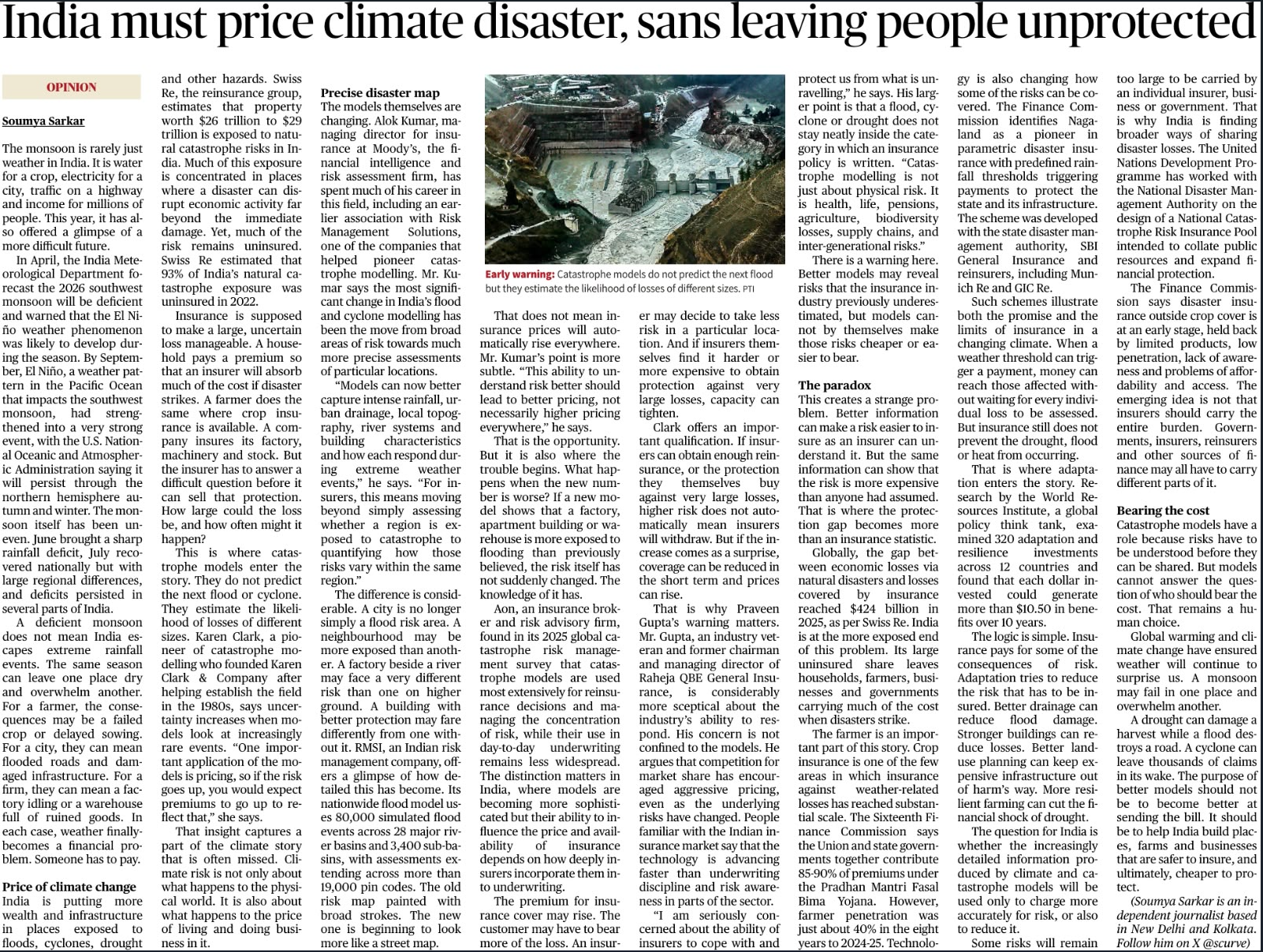
Article link: India: “A landscape that has lost its ability to hold water and to move it” | illuminem
Rob’s LinkedIn post reshared by me: https://lnkd.in/p/dG6GHqSa